Nuclear Option: Limiting Munitions

The impact of forcing logistics to be more forefront

It has almost been one whole year since I fully delved into the mission editor of Nuclear Option by Shockfront Studios. It started with me wanting to know how the nuclear blast backdropped air battles above sprawling land and sea combat actually worked. To my surprise it was much simpler than I was expecting with an effective set of triggers to create more complex scenarios while still being somewhat limited in ways I would not expect. I have made about a dozen missions, each of them focusing on different concepts to flex the mission editor to its limits. Some will see the light of day, others probably not.
My biggest takeaway is that logistics in Nuclear Option is more important to the overall player experience than it appears to be. Now that seems odd to say when players can throw 40 something standoff munitions and a half dozen nuclear weapons in the average play session. But it is the fine details that make it all happen.
You can define the logistics system into four parts:
Faction Funds used for purchasing ammunition and vehicles for players and NPCs.
Factories / Refineries to build vehicles and nuclear weapons
Hangars / Vehicle Depots deploying ground units and air vehicles
Munitions supplying ammunition to offensive and defensive units.
The most pertinent subject to this article is the Munitions. I feel as though Munitions specifically is somewhat misused. To the point that I would argue many large-scale single player and multiplayer missions from the Steam workshop and in the base game are somewhat mishandling them. Even missing opportunities with them.

Never Ending Air Defenses
Anyone that has played two or three Nuclear Option missions will notice that all forms of air defense are surprisingly consistent in intercepting bombs, missiles and rockets. It is to the point that saturation attacks really are the only valid tactic in high-end fights. As engaging as this may seem, honestly, having massive waves of guided missiles be swatted from the sky without fail can definitely wear down player's determination. You may need to be prepared to spend an hour or more to complete a reasonably sized mission.
In my mission editing and research, the root of this is often the presence of Munitions Container and Munitions Bunkers. Almost every unit within 100 to 300 meters of these is guaranteed to receive infinite ammunition as long as the munitions unit is not destroyed. Of course there are two sides of this. If these munitions units are destroyed, they can explode spectacularly destroying anything within a certain radius around them. Regular Munitions Crates are unarmored and highly vulnerable while Munitions Bunkers are harder to destroy.
Munitions Container. Munitions Bunker.
That seems like a great risk for reward setup. Though I would still argue that being too heavy handed with munition supply units near air defense units makes it all a high stress risk for reward that can feel heavily diminished. Dumping 20-something anti-tank missiles into a small group of self-propelled anti-aircraft guns for maybe one or two to get through can eventually wear on the player's experience. For players that are not skilled enough to deftly fly 1 meter off the surface, snap rolling and deploying countermeasures at the perfect moment, it can get old after the third or fourth attempt on the same cluster of targets. Though on the other end of the spectrum higher skill players still need the challenge.
How do you balance this?
Mission editors that do not place Munitions Crates or Munitions Bunkers near clusters of air defenses at the start of each mission can passively create opportunities and tasks for players and non-player-controlled (NPC) units without having to assign an elaborate set of triggers.
Limited Ammo, Valuable Tactics
Magazine depth for guided munitions is a significant real-world problem. It is especially prevalent in the 2020s. The rate at which guided weapons are expended and the consequences of not resupplying them quickly does translate well to Nuclear Option. Mission editors that do not place Munitions Containers or Munitions Bunkers near clusters of air defenses at the start of each mission can passively create opportunities and tasks for players and non-player-controlled (NPC) units without having to assign an elaborate set of triggers.
In the game it is usually the land and sea-based air defenses that launch infrared and radar guided missiles that run out of ammunition first. Units that deploy missiles are often the first ones to expend their interceptors due to their longer engagement ranges and effectiveness in intercepting air launched bombs and missiles from aircraft.
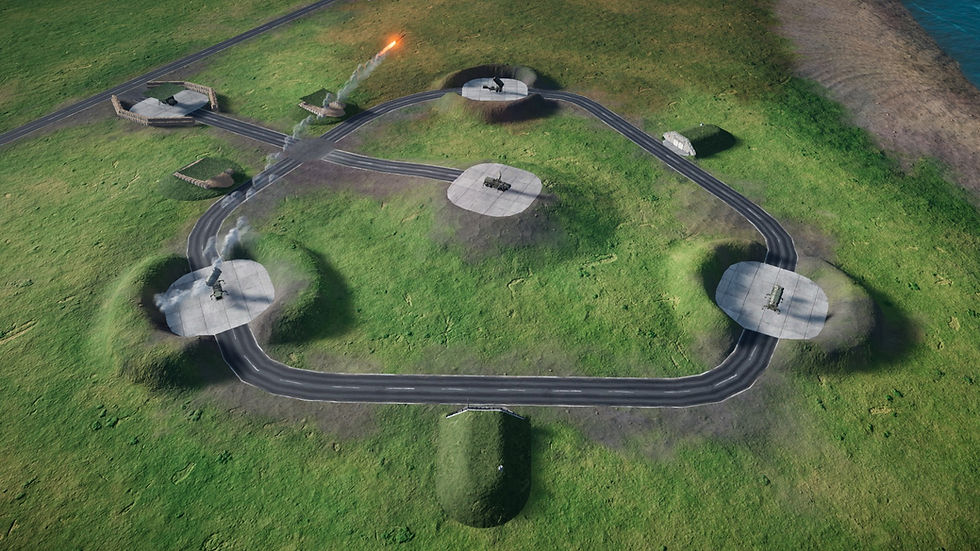
On one hand air defenses may be highly successful in stopping aircraft or incoming attacks for a time, but eventually they will run out of ammo despite their successes. On the other hand, with there being a limited number of interceptors on the battlefield, players can then use suppression of enemy air defense style tactics that intentionally cause enemy forces to burn through interceptors to leave them exposed.
Maybe hardened air defenses are gradually bled dry of missile stockpiles by deploying multiple low-cost glide bombs. Maybe old school Wild Weasel tactics are used, placing a lone aircraft in harm's way to intentionally draw fire and force a SAM site to waste missiles. Even if something like a far reaching Stratolance S9 surface-to-air missile site can be bled of its long-range missiles, it is effectively mission killed. This is the same for any other unit that remains in combat for an extended period of time.
With no missiles available and even anti-aircraft gun munitions gradually running short throughout the course of combat, this creates new situations for both players and NPC units to utilize to their advantage or take it upon themselves to fix.
NPC Logistic Missions
A side effect of restricting the placement of Munitions Crates and Munitions Bunkers at the start of a mission is that non-player-controlled units will automatically build and launch aircraft capable of carrying munition containers to resupply units that are out of ammo as the mission goes on. As of the time of this article being written, the two aircraft able to transport supplies in this role would be the UH-90 Ibis utility helicopter and the VL-49 Tarantula heavy vertical lifter.

The in-game logic will assign these missions without player input. However, with no direct control over the units, it is unknown which units will be rearmed first or in what order. This randomness causes a few things to happen.
When a resupply aircraft is built it takes up an active aircraft slot that could have been used by a fixed-wing combat aircraft. That is one less offensive focused aircraft in the air. When multiple units need resupply it is possible that for a time air threats significantly decrease if a large amount of resupply missions are called at the same time.

From the player's point of view, every hostile logistics laden helicopter may be in transit to drop a munition's crate next to a highly dangerous pocket of air defense. They become high priority targets worth the risk to destroy. That randomness also applies to allied helicopters who may spawn then spend time resupplying random anti-aircraft units that are far from units that are closer to the frontline line in dire need of resupply.
There is one guaranteed way to ensure that high priority units get the supplies they need quickly.
Player Driven Logistics
For players, units in need of ammunition create opportunities to fly logistics missions themselves. Destroying enemy units in direct combat certainly gives enough credits, but an equal amount of credits can be made resupplying entire SAM sites or clusters of anti-aircraft artillery. Besides the in-game currency payout to buy better aircraft and weapons, this brings friendly air defenses back online to continue the fight.

Flying with crates full of explosives is as dangerous as you would it expect it to be but flying into combat to deliver them greatly enhances the danger. Just like the enemy NPC helicopters that explode amazingly when you shoot them down, the same can happen to a player's transport aircraft. Even if a few cannon shells penetrate the hull of the aircraft. Player run logistic flights turn into a game of expertly flying to avoid danger and evade detection.
Fortunately, as of update 0.31, Nuclear Option lets aircraft both land and deploy munitions crates or paradrop them while in flight. While rolling them out the back of an aircraft to let parachutes bring them to the ground is the safest way to deliver supplies, it is also the most inaccurate method without a lot of practice. Learning the right airspeeds and distances to paradrop close enough to a unit in need of resupply takes practice.

Resupply At Sea
Perhaps one of the most understated parts of the logistics side of things is resupply of warships while at sea. These vessels are packed with various weapon systems and sensors that make them considerable threats to anything flying, driving or sailing in their reach. Whether its aircraft launching from carriers, long-range railgun fire or map crossing waves of anti-ship missiles, once their ship magazine is expended their ability to reach out and strike targets is lost. Eventually they too will be unable to defend themselves from consistent air attacks.
Currently there is nothing like a naval port to build new warships in the same way factories can build ground vehicles to be deployed from vehicle depots. Keeping the warships alive for as long as possible is the best way to utilize them.
Tarantula air dropping naval supply container to a friendly destroyer. Container being paradropped.
These naval vessels can be resupplied with Naval Supply Containers; a variant of the standard land-based munitions containers made to float in the ocean. Any warship that passes within 200 meters of a Naval Supply Container has ammunition resupplied for all weapon systems onboard the ship.
For a time, it was possible for the UH-90 and VL-49 to equip these navalized munitions crates from the destroyers, aircraft carriers and assault ships they could spawn from. This let a fleet at sea resupply itself within a few short minutes. However, that changed a few updates ago. Now all variants of the Munition Containers can only be loaded onto aircraft from pre-established land-based airports and air bases. Not even user made air bases can deploy them.
Resupply of warships now requires potentially long-range resupply missions from land to sea. Flying over the open ocean with few ways to defend the transporting aircraft can be risky, but when resupplying a nearly depleted Dynamo-class Destroyer yields upwards of 20 million credits per successful resupply, it is a risk worth taking.

A Heavylifter Future?
If social media polls mean anything it seems like Shockfront Studios may be fielding a design for a new heavy lifter aircraft. How such an aircraft could impact Nuclear Option is speculation for now, but it is undeniable that it would become a central part to the munitions branch of the game's logistics system. Hopefully the day comes when this potential heavy transport is a staple of the large-scale battles in this game's future.
Connect with Nuclear Option by Shockfront Studios
About the Writer

Co-founder of Skyward Flight Media. After founding Electrosphere.info, the first English Ace Combat database, he has been involved in creating flight game-related websites, communities, and events since 2005. He explores past and present flight games and simulators with his extensive collection of game consoles and computers. [Read Staff Profile]